Available from Bloomsbury Academic
“Flisfeder’s book is the rare case of a work which appears at the right moment doing the right thing. The Hysterical Sublime conclusively demonstrates that the ongoing global crisis of the Anthropocene is at its most fundamental not just an economic or social crisis but a properly metaphysical crisis centering on the very core of human subjectivity: it is not enough just do what is required from us, we have to rethink the entire frame of our posthuman situation in order to arrive at an adequate cognitive mapping of our predicament in 21st century capitalism. And what better way to do this than to begin with Flisfeder’s magnificent book!”
—Slavoj Žižek
“Our period is one of crisis. Against the growing hegemony of posthumanism as the ideology of twenty-first century capitalism, Matthew Flisfeder disrupts our received wisdoms about our time by showing how dialectical humanism can better conceptualize our understanding of the present. The Hysterical Sublime is an essential theoretical intervention which everyone must read!”
— Agon Hamza, Co-author of Reading Hegel (2021)
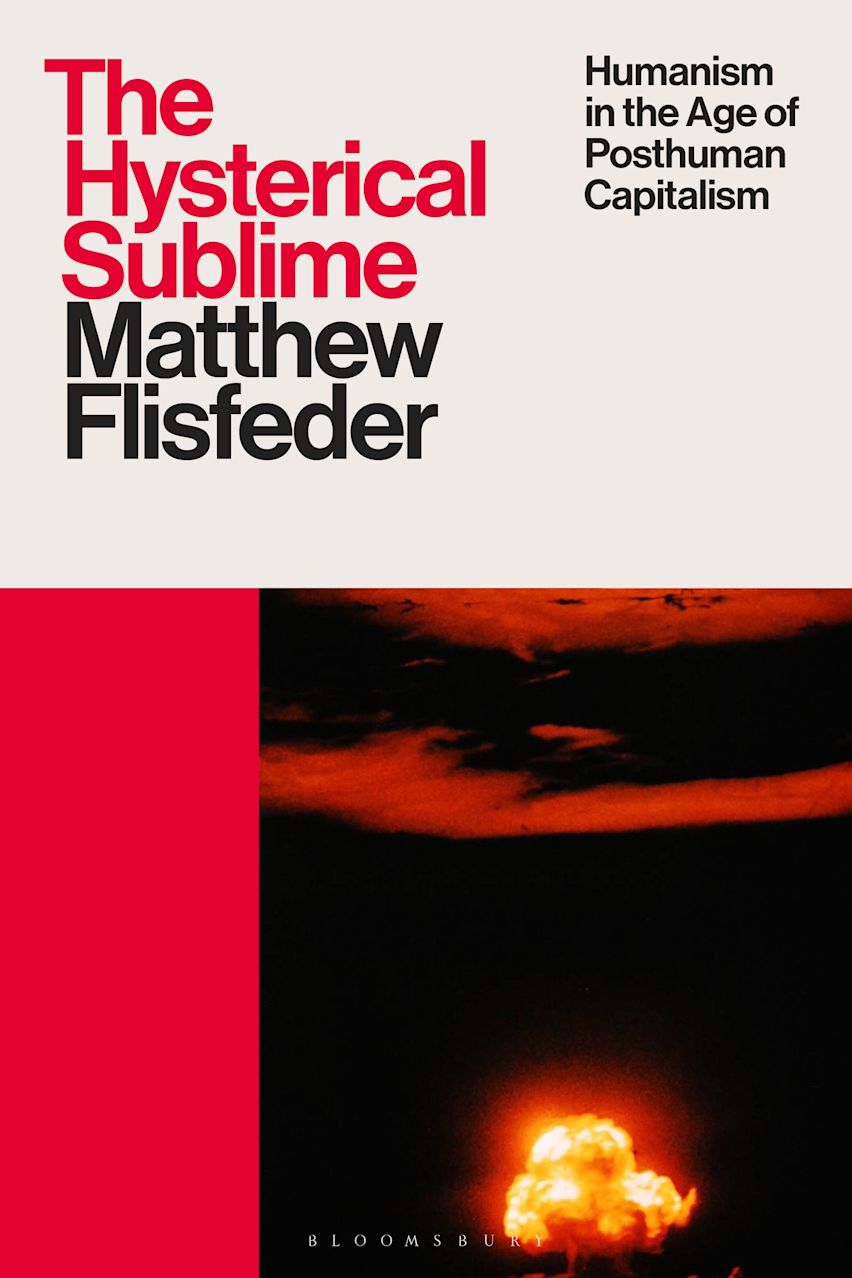
Developing the concept of the hysterical sublime, first theorised by Fredric Jameson, to challenge posthumanist perspectives on the Anthropocene, this book facilitates the rethinking of universal and dialectical humanism as concepts for grappling with 21st-century capitalism.
In recent years, posthumanist theories have been concerned with the overlapping dilemmas of global climate change, digital automation, and artificial intelligence, corresponding to the age of the Anthropocene. Matthew Flisfeder explores how the fear of technology becomes, for Jameson, a substitute for the fears of the capitalist system, and shows that posthumanism displaces such fears onto the figure of the human and anthropocentrism. Drawing on Hegelian-Lacanian theory, the book argues that to rethink dialectical humanism requires moving past the historicist versions of Marxist humanism that imagine a complete reconciliation with non-human nature that includes a process of dis-alienation. Flisfeder also studies posthumanism’s “performative contradiction” of dismissing humanism while at the same time depending on the very concepts that constitute the core of humanist thought: freedom, equality, responsibility, and autonomy.
Through the concept of the hysterical sublime, this book argues that, not only is anthropocentrism and humanism the unconscious core of posthumanist theory; emancipatory politics must take ownership of this perspective and renew universalist and dialectical humanism as the core of the political project resistant to capitalism and the Capitalocene.
 MATTHEW FLISFEDER